Tuesday, November 12, 2013

What James Krenov and Farley Mowat Have in Common


Last week we were shown a slideshow encompassing most of the pieces James Krenov made while working as an instructor at our school, over a period of 20 years or so.
The cabinets ranged from his traditional display cases mounted on stands, to some more wild and experimental pieces he made later in his career. David Welter explained how they were made and some of the thinking that went into the design and construction process.
But one of the photos was different, just an image of Krenov reading to the class from a book.
Photo courtesy of JamesKrenov.com (photo credit goes to David Welter)
It was explained to us that the book was “Sun, Sand and Stars,” the memoir of Antoine de Saint-Exupery, the French pilot and author who wrote “The Little Prince.”
Each year, David said, Krenov would read a passage where Saint-Exupery describes how he and the other pilots stationed with him in North Africa would keep an eye on the lanterns in their tents for signs of an approaching sand storm.
If new species of insects began to appear around the lamps at night, they knew they were being driven by a weather system coming towards the area, and to prepare for a storm.
Krenov used the passage to illustrate how we need to be aware of our environment, our materials and tools, and to learn to really see the changes taking place around us in order to become skilled, sensitive woodworkers.
I liked the story, and as a big fan of “The Little Prince” it inspired me to find Saint-Exupery’s memoir and read more.
The story also reminded me of the words of advice given to me by Farley Mowat, a legendary Canadian writer and environmentalist famous for writing about Canada’s Arctic people.
In the early 2000s I interviewed Farley because he happened to live in the small town where I worked as a newspaper reporter, and one of his short stories had been turned into a film called “The Snow Walker.”
It’s a story about a brash young bush pilot who only cares about himself and his machine, until he crashes in the Barrenlands in the company of a young Inuit girl, and has to rely on her to survive the harsh environment.
We talked about the movie, the book, Farley’s role, and then sat down to have a whiskey and cranberry juice along with Ted, the paper’s photographer.
Farley turned the tables, and asked me what was going on in my life. I told him it just so happened that I was about to head to Morocco for a year to volunteer with a Christian organization working in the region.
Farley, in his mid-80s at the time, almost jumped out of his seat: “You need to learn the lessons of The Snow Walker! You can’t go over there thinking you can teach people and change them and make their lives better until you understand them, their environment, and live alongside them!”
It was great advice and sparked a conversation about the nature of that type of work and the importance of being tuned into the things around you, the value of paying attention, seeing and feeling and being open to learn – things I now know James Krenov also valued, though in a slightly different context.
 In the end, I guess the goal for both Mowat and Krenov was the same. By being tuned into their surroundings, by always being willing to learn new things and become a student – they believed that their work, their lives, their interactions, became better as a result.
The fact that both of them produced incredible work right up until old age (Farley is still going strong), is one more reason to be inspired by their way of looking at the world.
At the end of David’s slide show, he said “and I thought you might like to see the real thing,” and casually brought out a Krenov cabinet – the first many of us had ever seen. It’s in the photo below…

Monday, November 4, 2013

In Woodworking it all Hinges on the Little Things


It seems I’ve been spending all my time and energy dealing with little things recently -- seemingly insignificant, unimportant challenges or problems that end up taking days or even a week to solve.

I recently wrote about the troubles I had getting the ‘wind’ out of my cabinet doors and ensuring they fit snugly against the sides with no rattle or gaps.

Then I moved on to hinges, and spent another week struggling -- cutting small pieces of brass, drilling and counter-sinking, pressing steel pins into the hinge leafs and striving for a smooth swivel action on a perfect 90* axis.
Bet these hinges don't look like they took 4 days to make. Or that they're garbage, But they did, and they are.

Those hinges finally got the OK (after an embarrassing number of botched sets), and this morning I started the week with a new task – making a ‘map’ of my cabinet and the doors in order to figure out exactly where the hinges will go, to ensure the doors swing open smoothly and close tightly.

Such a simple-sounding task, yet so crucial and fraught with so many potential errors. To minimize the chance of mistakes, we create a full-scale paper plan of the cabinet, complete with swinging cardstock to represent the doors, to find out where the pivot points need to be.

Once that relationship is established, we make a spacer that ensures all four hinges are set at the same distance from the sides. And finally we mark and cut the mortises for the hinges. My classmate Henry cut 30 test mortises on scrap wood before he felt comfortable enough to cut into his cabinet – it’s that tricky.

I don’t want to lose you in the details (if I haven’t already) but the point is that these little details add up. The reason it takes hours, days, or sometimes a week to accomplish something so simple, is that it needs to be done just right or the cabinet won’t be right.

And so, if it takes a week to make four simple brass hinges (that are made properly and work the way they should), that’s ok.

I wrote that as if I believe it, but I’m not sure I do just yet.

I still have that git-er-done mentality that fools me constantly into thinking I’m a failure and woodworking isn’t for me because I’m so painfully slow, and my mistakes are so glaring (at least to me), and I can’t simply Git. ‘Er. Done as I can in other areas of my life.

But there’s a quote by Samuel Johnson on the wall at the front of our workshop that I find myself turning to more and more in those moments of self-doubt. It says: “What we hope ever to do with ease, we must first learn to do with diligence.”

I’ve been taking comfort in those words and the truth they represent. Difficult tasks eventually become easier, but only after a lot of effort, pain, and even failure.

I’ve been trying to remind myself of that when I struggle through a hard week of seemingly constant failures, what I’m actually doing is learning “to do with diligence” the things that will hopefully, possibly, some day come with ease.
Finally, hand-made hinges that will work the way they're meant to!


Friday, October 25, 2013

Stepping Back to Move Forward

I woke up at 4 am this morning out of a deep sleep, wide awake with an idea about how I could solve the latest problem with the cabinet I’m building.
The waking-up thing has happened a few times this week, but usually it’s been accompanied by an anxious ‘what am I going to do’ kind of feeling – and without the answers.
The week has been stressful, as I’ve spent almost all of it trying to chase out a gap where the doors will meet the cabinet sides. It feels silly to write and it probably feels that way to read as well. It was just a small gap – in a place that will have a gap anyway when the doors and hinges are actually installed.
But I want everything to be as close to perfect as possible in this piece, and a weird mystery gap just isn’t acceptable.
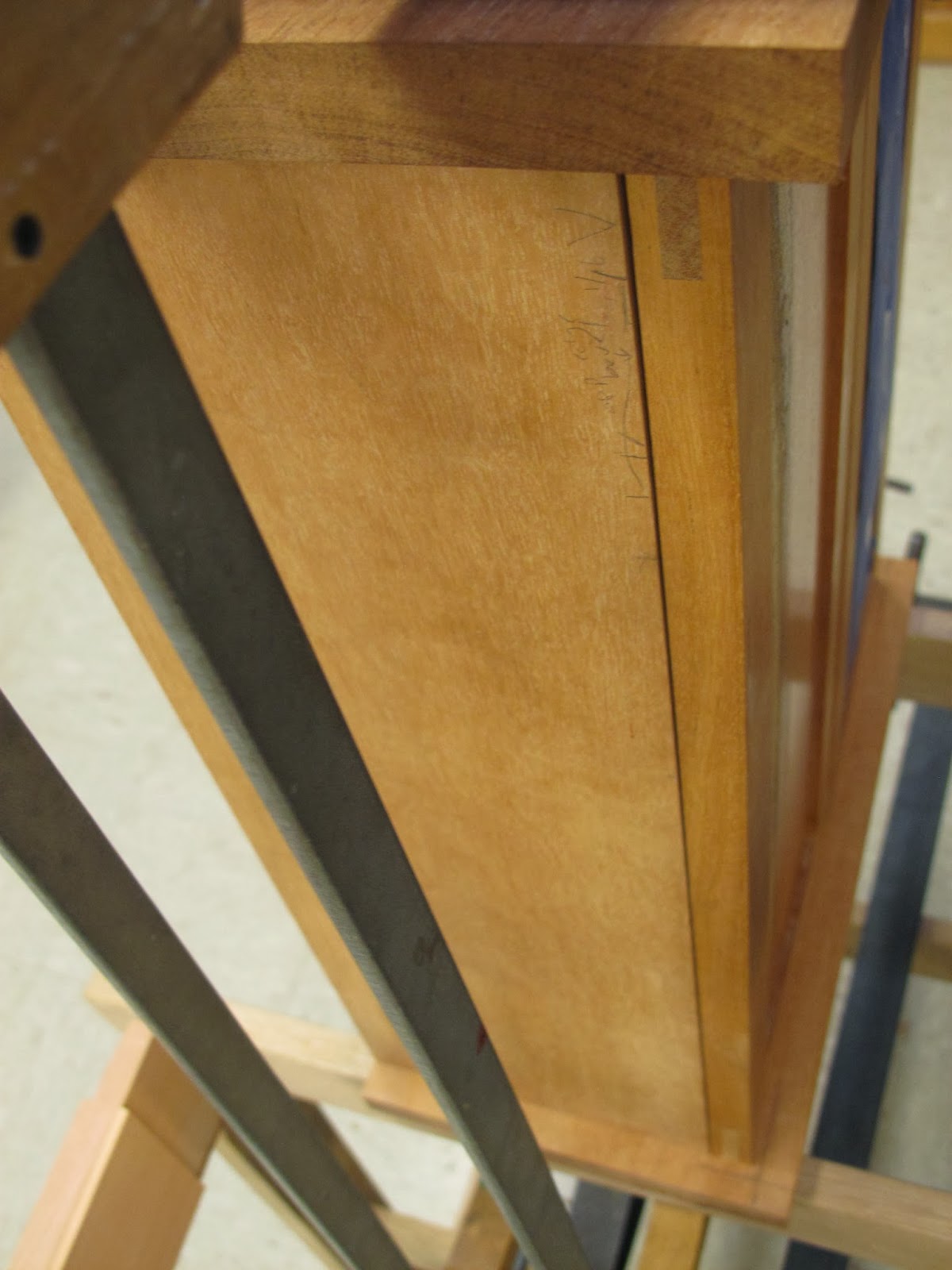
Photo shows the gap between the door and the cabinet side.
In a perfect world, the sides of the cabinet would be flat and square, and the doors would be flat and square, and everything would come together tight and gap-free. But that wasn’t happening for me.
I spent four straight days scraping a little here, sanding a little there, planning over here, and by the end of day Thursday the thing looked worse than it did on Monday morning. I was trying to sculpt two imperfect pieces of wood together and it just wasn’t working.
My epiphany at 4 am was this: Take a step back. Flatten the doors and the cabinet sides, essentially taking them back to where the started, and see what happens.
Funnily enough, my bench mate Jim had the same idea this morning, and so did Laura, my instructor.
So I did it. Four days of work down the drain, but when I reset all those edges, and made one additional adjustment, they came together as tight and perfect as I could have hoped.
No more gap!

And I was happy, and could go to Elephants (Friday night beers around the woodshop bonfire) with a clear conscience and an accomplishment to actually celebrate.
It’s strange, this type of work. Small, seemingly insignificant challenges can occupy days of work and can cause all kinds of stress. But when you get there, when you finally figure it out and are able to move on, it’s incredibly rewarding – and you learn so much in the process.
I may have only got one thing done this week, but I know I learned lessons that will stay with me for years to come. And I’m one step closer to a finished cabinet.


Thursday, October 10, 2013

How a Bad Day Resulted in Prettier and Better Cabinet Doors

Last Saturday was a bad day.
I had spent a few days working on the panels for the two doors that would enclose the front of the cabinet I'm building, and would therefore be the centrepiece of the whole project. The doors would be built first, then the rest of the cabinet built around them, so they had to be just right.
I had chosen to use mahogany that was spalted – a type of fungal disease that attacks trees, but often leaves them with beautiful and unusual patterns and colours.
But the problem was that part of the spalted edge, which would comprise part of a ‘live-edge’ component of my cabinet doors, was also slightly worm-eaten and a little rotten.
I had thought I could work with it and live with the worm holes, and that the uniqueness of it would make up for any structural issues in the wood.
But then on Friday, as I was cutting a profile into the edge of the panels, the corner of one ripped off, its lack of structural integrity causing weakness in the wood.
Here are the original panels, with one broken corner visible in the top left.

I was able to re-attach the broken corner and salvage the piece, and was pretty happy with the repair job -- the fixed fracture was almost invisible.
Then on Saturday, as I was shellacking my panels, the second piece slipped out of my hands and landed on the floor, the weak corner exploding into a million pieces.
Bad way to end the week.
I went home, tried to forget about the disaster, and enjoyed Sunday away from the workshop, though in the back of my mind the wheels were turning as to how I could resolve the conundrum.
By Monday I had made up my mind. I bought a new piece of mahogany first thing in the morning -- a different board but cut from the same section of the same tree – and began making new panels.
But this time I avoided the rotten section and was able to cut strong, solid panels that were easily as pretty as the original set, but had no worm holes, rot, or strength issues.
And because I had just gone through the process of making the original panels, I was able to do it quickly and without stress.
By the end of the day I had beautiful new panels that were cut to size, sanded, shaped and ready for shellac.
Here are the new panels after treatments of shellac and wax, ready to become doors.

The experience reminded me that sometimes a mistake, or an apparent unexpected setback in a woodworking project, can force the maker to take a step back, reconsider his plans, and sometimes come up with a much better approach.

That’s what happened this time, and I’m pretty happy about how it all turned out.
Here are the panels glued-up in the frames. Their positions will be reversed on the actual cabinet, with the live edges on the outside edge of each door.

Wednesday, October 2, 2013

Inspiration Comes Full Circle and How Furniture Can Capture the Heart


James Krenov used to say that when someone falls in love with a piece of furniture, they’ll do anything to own it -- re-mortgage their house, sell their first-born – whatever it takes. They have to have it.
I guess that’s what a fine woodworker has to depend on if they’re going to survive. When a piece takes weeks, even months to complete, it needs to sell for a decent price if the craftsman who made it is going to be able to survive.
As it turns out, it’s not only ‘customers’ who can come under the spell of a piece of furniture.
Recently, one of our instructors at the College of the Redwoods, David, shared with us a mock-up for a chair he is building.
David said he hasn’t built much in recent years, and his creative bent has been fulfilled by helping us students get started on our own projects and careers. And he helps us immensely every day, from showing us how certain tools work, to parting with precious pieces of lumber he has collected over the years, to simply looking at a problem and saying “here, try this.”
But before he got into showing us his chair mock-up, David told us about one of the exceptional alumni at the school, Sarah Marriage (mentioned in an earlier post here), and showed us photos of some of her projects. She made some truly inspiring, beautiful pieces.
After going through the slides, David showed us a writing desk Sarah had built, and said he had fallen in love with it as she designed and built it in the shop at our school.
“So, I decided to save her the trouble of shipping it off to a gallery, and bought it from her myself,” he told us.
What a compliment. Anyhow, the writing desk has sat in his home for several years, but without a chair. Recently he was stirred, came up with a design, and began putting the model together.
David was inspired by the work of a student, and I, and others, were inspired by the realization that even someone who has seen literally thousands of pieces of beautiful furniture come through the school, could still be captivated by the simple lines contained in a writing desk conceived and built by a student.
Amazing.

Wednesday, September 25, 2013

Krenov on making furniture for 'Those People'


Just wanted to share something I read recently by James Krenov, about what he calls ‘Those People’ and the notion that fine woodworkers often struggle with making furniture for the very rich – because they are among the few who can afford it – and how that isn’t always a pleasant circumstance.
Here are his thoughts on that:
“Traveling reminds me again that there is little or no connection between wealth and that thing called good taste. Nor does money make someone a better person, or a worse person either. What it probably amounts to, for some of us at least, is that we are doing honest work, out best, with feeling in it, and we hope to meet people who will appreciate and want it. Some poor people with whom we get along very well will understand and say that they are sorry, but….
“Another person, of modest means perhaps, might ask to pay a bit at a time, and something tells us to trust him or her. Wealthy people come and ask the wrong questions and we feel so uneasy that some of us just do not care to let them have the piece, But there are also some with money and taste and a simple warmth that gets through our ‘those people” filter: we enjoy telling them about our work, they listen – there is contact, a kind of understanding.
“Nothing else matters, really. It is all about people…the only qualification being that they are the kind of people who do not make us unhappy at our work or about our work – this is vital.” – James krenov (The Impractical Cabinetmaker)
I just liked those words and the sentiment behind them. Hope you do too.

Tuesday, September 24, 2013

How To Turn a Sow's Ear Into a Silk Purse

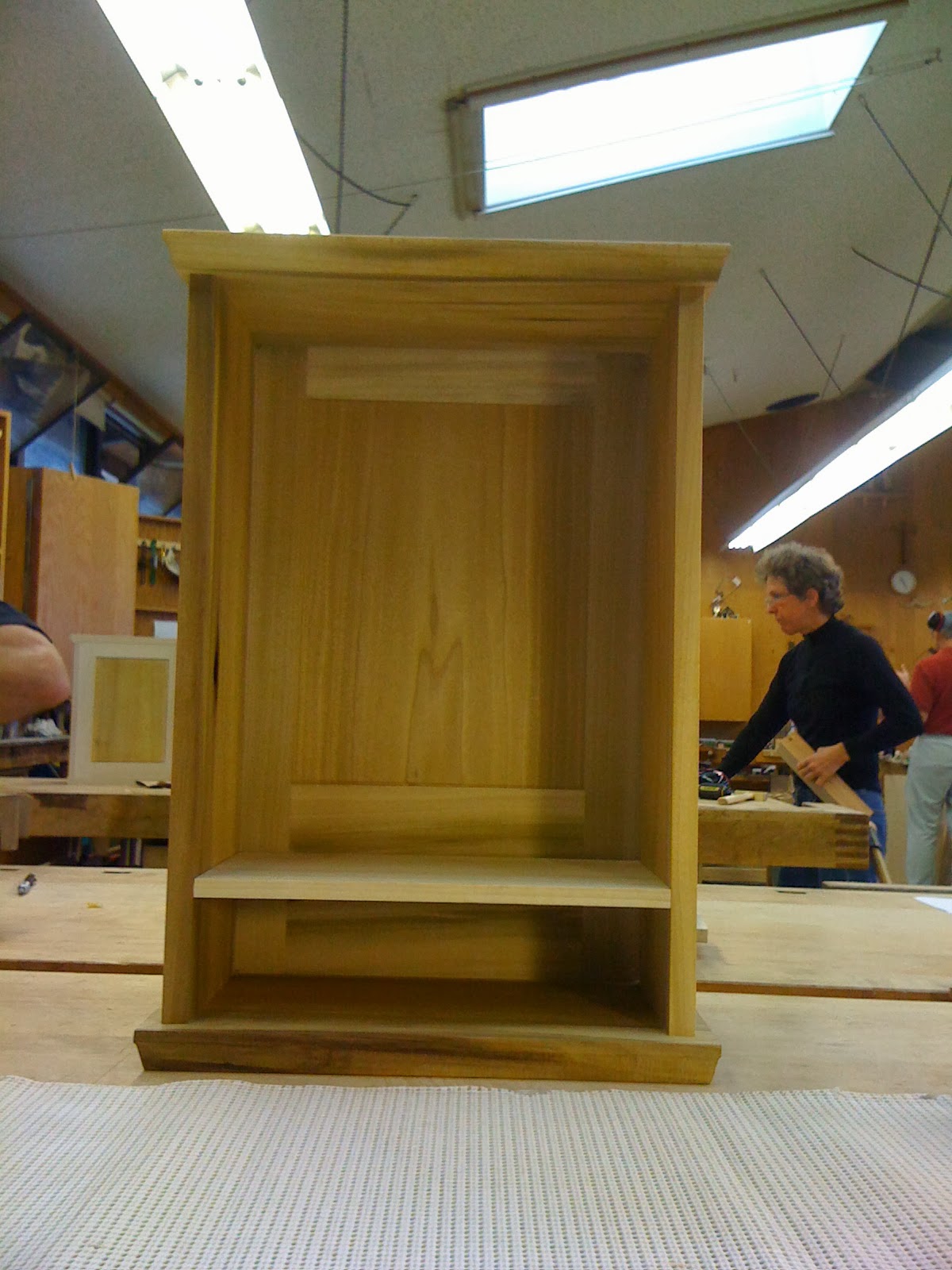
My 'sow's ear,' right, and the frame and panel clamped together for glue-up, to the left.
There’s an old saying that goes like this: ‘You can’t turn a sow’s ear into a silk purse.’
I always liked the expression because it’s so visual, you can’t help but picture the process of trying to do just that, and the grotesque, inevitable end result.
Our last assignment before moving on to our first major project was called the ‘Sow’s Ear’ exercise.
We were given a big chunk of poplar – an inexpensive, generally unattractive wood most people consider to be ‘paint grade,’ and given a list of smaller boards to mill out of the thick, heavy plank.
Then, we surfaced the wood, made our final cuts, and prepared to join the pieces into a cabinet, starting with the frame – essentially two sides and a top and bottom, joined together with dowels.
Once that was done, we constructed a frame-and-panel for the back of the cabinet, and decided on design elements such as shelves and doors. Some students even decided to make drawers.
Essentially, the assignment was meant to pull together a bunch of the skills we had learned, teach us some vital new ones, and give us the experience of building a complete piece from start to finish, before moving on to the real thing.
It was a lot of fun, but also stressful. We’re lucky enough to be enrolled at one of the more esteemed and well-known woodworking schools in the U.S., and the pedigree here is high. A lot of incredible woodworkers have come through here and made names and successful careers for themselves. Most of us want to do that too.
As a result, there’s a general desire among people here to do everything well. Which is where the name of the exercise comes from. Even though this is essentially just practice, many of us stressed over our little cabinets, lost sleep, spent days struggling with certain details. All in an effort to turn a sow’s ear into a silk purse – something we all know is impossible.
But anyway, in the end, though it’s made with cheap, unattractive wood, there’s something about this little creation that makes me happy, looking at it sitting beside my workbench.
Maybe it’s because it represents another step in this journey of becoming a woodworker, and the process of accepting that the struggle towards perfection is sometimes enough.
The final product!